Articles
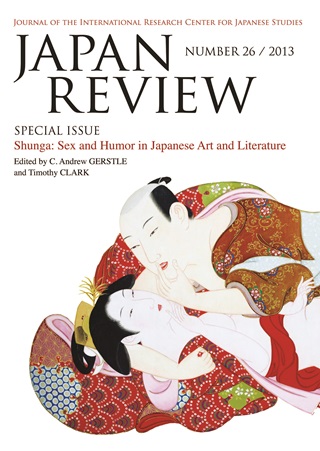
Analyzing the Outrageous: Takehara Shunchosai's Shunga Book Makura doji nukisashi manben tamaguki (Pillow Book for the Young, 1776)
Abstract
This article examines the book Makura doji nukisashi manben tamaguki (1776) with illustrations by Takehara Shunchosai in the context of a sub-genre of shunga books--erotic parodies of educational textbooks (ōrai-mono)--produced in Kyoto and osaka in the second half of the eighteenth century. A key question is whether we should read this irreverent parody as subversive to the political/social order, and if so in what way.
Different from the erotic parodies by Tsukioka Settei, which focused mostly on women's conduct books, this work is a burlesque parody of a popular educational anthology textbook used more for boys. It depicts iconic historical figures, men and women, courtiers, saurai and clerics all as obsessed with lust, from Shōtoku Taishi, through Empresses and Kōbō Daishi to Minamoto no Yoshitsune. The article considers whether recent research on Western parody as polemic is relevant to an analysis of this and other Edo period parodies. The article also considers the view, within Japanese scholarship, on the significance of parody (mojiri, yatsushi, mitate) in Edo period arts. The generation of scholars during and immediately after World War II, such as Aso Isoji (1896-1979) and Teruoka Yasutaka (1908-2001) tended to view parody and humor as a means to attack the Tokugawa system, but more recent research has tended to eschew such interpretations. The article concludes by placing this work among other irreverent writing/art of the 1760s-1780s, in both Edo and Kyoto/Osaka, which was provocative and challenged the Tokugawa system.
This article examines the book Makura doji nukisashi manben tamaguki (1776) with illustrations by Takehara Shunchosai in the context of a sub-genre of shunga books--erotic parodies of educational textbooks (ōrai-mono)--produced in Kyoto and osaka in the second half of the eighteenth century. A key question is whether we should read this irreverent parody as subversive to the political/social order, and if so in what way.
Different from the erotic parodies by Tsukioka Settei, which focused mostly on women's conduct books, this work is a burlesque parody of a popular educational anthology textbook used more for boys. It depicts iconic historical figures, men and women, courtiers, saurai and clerics all as obsessed with lust, from Shōtoku Taishi, through Empresses and Kōbō Daishi to Minamoto no Yoshitsune. The article considers whether recent research on Western parody as polemic is relevant to an analysis of this and other Edo period parodies. The article also considers the view, within Japanese scholarship, on the significance of parody (mojiri, yatsushi, mitate) in Edo period arts. The generation of scholars during and immediately after World War II, such as Aso Isoji (1896-1979) and Teruoka Yasutaka (1908-2001) tended to view parody and humor as a means to attack the Tokugawa system, but more recent research has tended to eschew such interpretations. The article concludes by placing this work among other irreverent writing/art of the 1760s-1780s, in both Edo and Kyoto/Osaka, which was provocative and challenged the Tokugawa system.