Articles
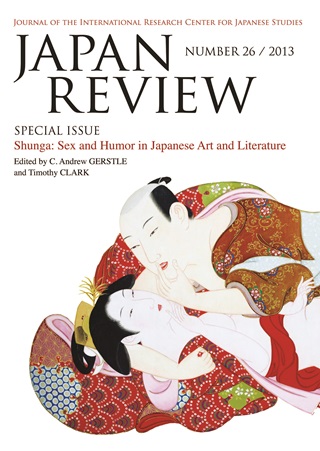
Japanese Illustrated Erotic Books in the Context of Commercial Publishing, 1660-1868
Abstract
Edo-period illustrated erotic books (hereafter shunpon) were commodities intended for a mass market, the products of an intensely competitive industry. Shunpon consistently ranked among the great achievements of commercial book production, eliciting the best from artist, block cutters and printers. In them we regularly encounter high aesthetic standards, fine papers and sophisticated printing techniques, and, eventually, the richest colour palettes and most elaborate covers. Despite being banned in 1722, production resumed by the late 1740s and continued on a significant scale to the end of the period without significant hinderance from the authorities. The bindings and sizes in which shunpon were issued had an impact on the disposition of images and texts. Their visual and literary content was often used and reused, both licitly and illicitly. In pursuit of profit, publishers switched, adapted, replaced, pirated, imitated, modified, combined and recombined texts and images. There is no hard evidence relating to the funding of shunpon. It appears that some of the most elaborate examples were subsidised by wealthy subscribers. However, the owners of rental libraries carried numbers of them in their stock without untoward consequences; they must also have played an important role in underwriting the production of higher quality material, particularly in the nineteenth century. Edo-period illustrated erotic books (hereafter shunpon) were commodities intended for a mass market, the products of an intensely competitive industry. Shunpon consistently ranked among the great achievements of commercial book production, eliciting the best from artist, block cutters and printers. In them we regularly encounter high aesthetic standards, fine papers and sophisticated printing techniques, and, eventually, the richest colour palettes and most elaborate covers. Despite being banned in 1722, production resumed by the late 1740s and continued on a significant scale to the end of the period without significant hinderance from the authorities. The bindings and sizes in which shunpon were issued had an impact on the disposition of images and texts. Their visual and literary content was often used and reused, both licitly and illicitly. In pursuit of profit, publishers switched, adapted, replaced, pirated, imitated, modified, combined and recombined texts and images. There is no hard evidence relating to the funding of shunpon. It appears that some of the most elaborate examples were subsidised by wealthy subscribers. However, the owners of rental libraries carried numbers of them in their stock without untoward consequences; they must also have played an important role in underwriting the production of higher quality material, particularly in the nineteenth century.